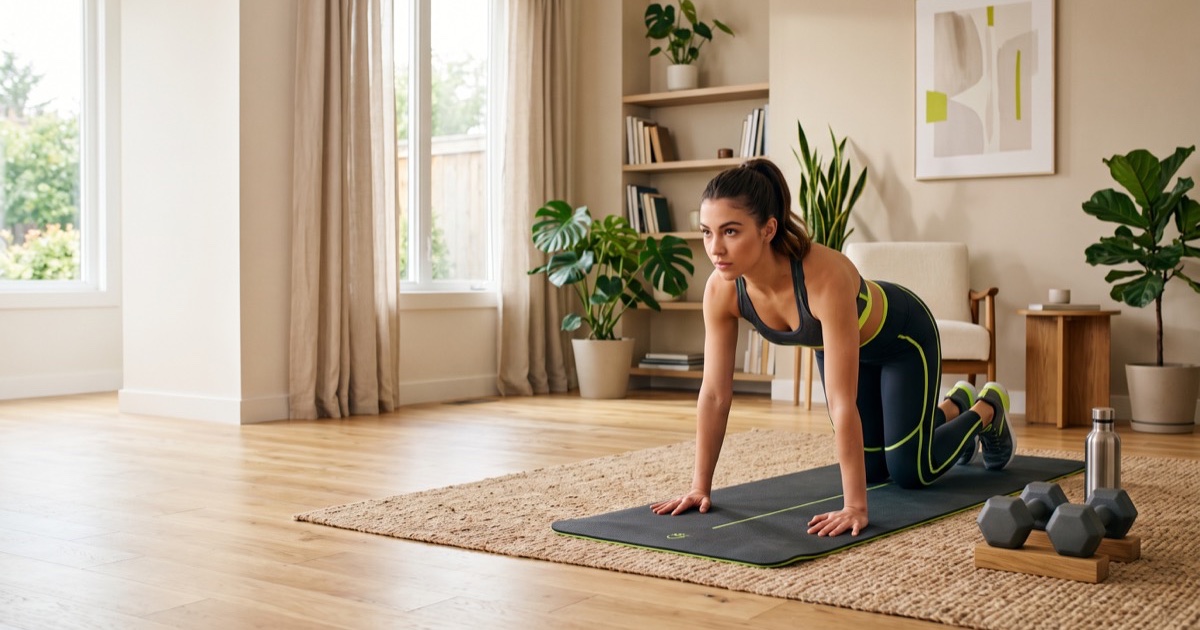
A good home workout plan does not need expensive equipment, two-hour sessions, or a perfect spare room. It needs a small set of movements you can repeat, a way to make them gradually harder, and a schedule you can actually keep. Start with three full-body workouts per week and you can build strength, improve fitness, and support fat loss from home.
The mistake is treating home training as random sweat sessions. Burpees and endless ab circuits may feel hard, but a plan produces better results because it trains your legs, pushing muscles, pulling muscles, core, and conditioning in a balanced way. This guide gives you a practical plan for beginners and shows how to progress it whether you have no equipment, bands, or dumbbells.
What Makes a Home Workout Plan Effective
The principles are the same whether you train in a garage or a commercial gym: train close enough to fatigue, use good technique, recover, and add a little challenge over time.
Focus on five movement patterns:
- Squat: sit-to-stands, bodyweight squats, split squats, or goblet squats.
- Hinge: glute bridges, hip thrusts, Romanian deadlifts, or single-leg deadlifts.
- Push: incline push-ups, floor push-ups, overhead presses, or pike push-ups.
- Pull: band rows, dumbbell rows, towel rows, or pull-ups if you have a bar.
- Core: planks, dead bugs, side planks, and carries.
You do not need a dozen exercises per workout. Two or three sets of a few useful movements done consistently will outperform a complicated plan you abandon after a week.
Choose the Right Starting Point
Use the version that matches your current ability. The last two or three repetitions of each set should feel challenging while your form stays controlled. If you could easily do ten more repetitions, make the variation harder. If you cannot complete the lowest number with good form, make it easier.
No Equipment
Bodyweight is enough to begin. Use a chair or countertop to adjust the difficulty of push-ups, and use a backpack with books once squats and bridges become too easy.
Resistance Bands
Bands are one of the most useful low-cost additions because they make rows, presses, pull-aparts, and deadlifts easy to load. Choose a resistance that lets you work in the target rep range without rushing.
Dumbbells
With a pair of dumbbells, you can make a home workout plan progressively harder for a long time. Prioritise goblet squats, Romanian deadlifts, rows, floor presses, and overhead presses.
The 3-Day Home Workout Plan
Train on non-consecutive days, such as Monday, Wednesday, and Friday. Before each workout, spend five minutes marching, doing arm circles, bodyweight squats, and easy versions of the first exercise.
Workout A
- Bodyweight or goblet squat — 3 sets of 8–15 reps
- Incline, knee, or full push-up — 3 sets of 6–12 reps
- Band or dumbbell row — 3 sets of 8–15 reps per side
- Glute bridge — 3 sets of 12–20 reps
- Dead bug — 3 sets of 6–10 reps per side
Rest for 60 to 90 seconds between sets. For a harder squat, slow the lowering phase to three seconds or switch to a split squat.
Workout B
- Reverse lunge or split squat — 3 sets of 6–12 reps per side
- Dumbbell floor press or push-up — 3 sets of 8–15 reps
- Romanian deadlift with dumbbells, band, or backpack — 3 sets of 8–15 reps
- Band pull-apart or reverse snow angel — 3 sets of 12–20 reps
- Front plank — 3 sets of 20–45 seconds
Use a wall or chair for balance during lunges. The goal is controlled range of motion, not speed.
Workout C
- Step-up or squat variation — 3 sets of 8–15 reps per side
- Pike push-up or overhead press — 3 sets of 6–12 reps
- Single-arm row or towel row — 3 sets of 8–15 reps per side
- Single-leg glute bridge — 3 sets of 8–12 reps per side
- Side plank — 3 sets of 15–30 seconds per side
If you do not have a safe pulling option, use band pull-aparts and prone Y-T-W raises until you can add a band or dumbbell. Avoid improvising with unstable furniture.
How to Progress at Home
Progressive overload is what turns a home routine into a strength plan. Pick one change at a time:
- Add one or two repetitions while keeping form consistent.
- Add a set, up to four sets for the main movements.
- Slow the lowering phase or pause in the hardest position.
- Move to a harder variation, such as incline push-up to floor push-up.
- Add load with a band, dumbbell, or weighted backpack.
Keep a simple note of the exercise, load, sets, and reps. When you can reach the top of the rep range on every set, use the next progression. This is the same principle used in a beginner gym workout plan; the equipment changes, but the need to improve gradually does not.
Add Cardio Without Undermining Strength
For general health and fat loss, add brisk walks, cycling, dancing, or short low-impact circuits on one or two days between strength workouts. Start with 20 to 30 minutes. You do not have to turn every session into high-intensity cardio to get results.
If fat loss is your main goal, pair this plan with a moderate calorie deficit and adequate protein. A structured 5-day workout split for weight loss can be a useful next step once you have built the habit and recover well from three weekly sessions.
Common Home Workout Mistakes
Chasing exhaustion instead of progression
Being drenched in sweat does not automatically mean the workout will build strength. Use movements that you can repeat and measure, then make them harder over time.
Ignoring pulling movements
Push-ups are easy to remember, but your upper back needs work too. Bands and dumbbells make rows simple; without them, use safe bodyweight pulling variations rather than skipping the pattern entirely.
Changing the routine every day
Variety is fun, but too much of it hides progress. Run this plan for six to eight weeks before replacing the main movements. Small changes in reps, load, and variations are enough.
Training through pain
Muscle effort and mild soreness are normal. Sharp pain, joint pain, dizziness, or symptoms that worsen during a session are not. Stop the movement and seek qualified medical advice when appropriate.
Make the Plan Fit Your Schedule
Consistency beats the perfect schedule. If three days feels impossible, start with two alternating sessions: Workout A in week one, Workout B next, then Workout C. If 45 minutes is too long, do the first three exercises and add the core work on a walk day.
Your PT can turn your available time, equipment, experience level, and goal into a tailored routine. Use the free workout plan generator to get a plan that adapts as you gain strength instead of guessing when to change things.
The Bottom Line
A home workout plan works when it is balanced, challenging, and repeatable. Start with three full-body sessions, train each movement with control, and progress one small variable at a time. You can get strong at home before you ever need more equipment—or a gym membership.
Frequently Asked Questions
- Can I build muscle with a home workout plan?
- Yes. Muscle grows when exercises are challenging enough and become progressively harder over time. At home, use harder movement variations, more repetitions, slower lowering phases, shorter rest periods, or added resistance from bands, dumbbells, or a backpack.
- How many days a week should I work out at home?
- Three full-body sessions per week is an effective starting point for most people. If you already recover well and enjoy training, move to four sessions by alternating upper- and lower-body emphasis.
- What equipment do I need for a home workout plan?
- You can start with no equipment at all. A resistance band, a pair of adjustable dumbbells, and a stable chair make progression easier, but they are helpful upgrades rather than requirements.
- How long should a home workout take?
- Aim for 30 to 45 minutes. That is enough time for a warm-up, several focused strength exercises, and a short cooldown without making the routine difficult to sustain.